BUSINESS NEWSAPRIL 22, 2018 / 1:14 PM /
BEIJING (Reuters) - China on Sunday said it welcomed plans by top U.S. officials to visit the country to discuss trade and economic issues, amid tensions between the world’s two largest economies.
FILE PHOTO - Flags of U.S. and China are placed for a meeting between Secretary of Agriculture Sonny Perdue and China's Minister of Agriculture Han Changfu at the Ministry of Agriculture in Beijing, China June 30, 2017. REUTERS/Jason Lee
“The Chinese side has received information that the U.S. side hopes to come to Beijing to discuss economic and trade issues. China welcomes this,” a short statement on the commerce ministry’s website said.
U.S. Treasury Secretary Steven Mnuchin said on Saturday he was continuing to have discussions with his Chinese counterparts to try to resolve the differences over trade, and said he may travel to China.
“I am not going to make any comment on timing, nor do I have anything confirmed, but a trip is under consideration,” Mnuchin said.
Reporting by Gao Lianging and Elias Glenn; Editing by Stephen Coates
Our Standards:The Thomson Reuters Trust Principles.
FROM: https://uk.reuters.com/article/uk-usa-trade-china/china-welcomes-u-s-to-visit-china-to-discuss-trade-idUKKBN1HT04X
Friday, May 4, 2018

Thursday, May 3, 2018
19 Singapore firms to exhibit ideas, products at Hannover Messe trade fair
By Brandon Tanoto
23 Apr 2018 12:00AM(Updated: 23 Apr 2018 12:00AM)
HANNOVER: A total of 19 Singapore companies are showcasing their newest ideas and products at Hannover Messe – the world’s largest trade fair for industrial technology – in Hannover, Germany from Monday (Apr 23) to Friday (Apr 27).
These companies include Singapore Technologies Kinetics, automation equipment supplier Pixel Automation, manufacturer Sanwa Group and 3D printing services provider Creatz3D.
The fair gives them a platform to find global partners to collaborate with and an opportunity to network with key industry players.
The event is expected to attract over 250,000 visitors this year. Last year’s edition of Hannover Messe attracted over 200,000 attendees from more than 70 countries.
Minister for Trade and Industry (Industry) S Iswaran is leading a delegation of more than 20 Singapore enterprises to tour the fair and visit the Singapore exhibitors from Apr 23 to 25. He will be accompanied by officials from the Ministry of Trade and Industry, the Ministry of Foreign Affairs and other economic agencies.
With advanced manufacturing identified as one of the growth clusters, MTI has said that it is opportune that Singapore has a presence at the fair, because it will give the country a leg up in its push into advanced manufacturing and in cementing its position as a global manufacturing hub.
During his trip, Mr Iswaran will be speaking at two forums – the Germany-Singapore Business Forum and the ASEAN Forum 2018 – where he will talk about how global firms can team up with Singapore companies to access opportunities in ASEAN. He will also promote business partnerships between German and Singaporean enterprises.
Mr Iswaran will also witness the signing of a Memorandum of Understanding between government agency Enterprise Singapore and German Accelerator – a growth acceleration programme for German startups. The deal will be aimed at boosting market access and economic ties between both countries.
Source: CNA/mz/(ra)
By Brandon Tanoto
(Updated: 23 Apr 2018 12:00AM)
23 Apr 2018 12:00AM(Updated: 23 Apr 2018 12:00AM)
HANNOVER: A total of 19 Singapore companies are showcasing their newest ideas and products at Hannover Messe – the world’s largest trade fair for industrial technology – in Hannover, Germany from Monday (Apr 23) to Friday (Apr 27).
These companies include Singapore Technologies Kinetics, automation equipment supplier Pixel Automation, manufacturer Sanwa Group and 3D printing services provider Creatz3D.
The fair gives them a platform to find global partners to collaborate with and an opportunity to network with key industry players.
The event is expected to attract over 250,000 visitors this year. Last year’s edition of Hannover Messe attracted over 200,000 attendees from more than 70 countries.
Minister for Trade and Industry (Industry) S Iswaran is leading a delegation of more than 20 Singapore enterprises to tour the fair and visit the Singapore exhibitors from Apr 23 to 25. He will be accompanied by officials from the Ministry of Trade and Industry, the Ministry of Foreign Affairs and other economic agencies.
With advanced manufacturing identified as one of the growth clusters, MTI has said that it is opportune that Singapore has a presence at the fair, because it will give the country a leg up in its push into advanced manufacturing and in cementing its position as a global manufacturing hub.
During his trip, Mr Iswaran will be speaking at two forums – the Germany-Singapore Business Forum and the ASEAN Forum 2018 – where he will talk about how global firms can team up with Singapore companies to access opportunities in ASEAN. He will also promote business partnerships between German and Singaporean enterprises.
Mr Iswaran will also witness the signing of a Memorandum of Understanding between government agency Enterprise Singapore and German Accelerator – a growth acceleration programme for German startups. The deal will be aimed at boosting market access and economic ties between both countries.
Source: CNA/mz/(ra)
By Brandon Tanoto
(Updated: 23 Apr 2018 12:00AM)
Wednesday, May 2, 2018
Merkel stresses importance of free trade ahead of visit to U.S
THIS CONTENT WAS PUBLISHED ON APRIL 22, 2018 8:21 PMAPR 22, 2018 - 20:21

(reuters_tickers)
HANOVER, Germany (Reuters) - German Chancellor Angela Merkel on Sunday stressed the importance of free trade and welcomed an agreement between the European Union and Mexico on a new trade pact just days before she heads to Washington for talks with President Donald Trump.
U.S. policy has become more protectionist under Trump, who during his election campaign blamed globalisation for ravaging American manufacturing jobs as companies sought to reduce labour costs by relocating elsewhere. In March he imposed tariffs on imports of steel and aluminium to protect U.S. producers.
Merkel is due to address contentious issues including trade when she meets Trump on Friday.
Speaking at the opening of the Hanover trade fair in Germany, Merkel and visiting Mexican President Enrique Pena Nieto welcomed the agreement in principle that the EU and Mexico reached on Saturday on a new free trade deal.
"The technical work should take place quickly now but it's really good news for Europe, for Germany and for Mexico," Merkel said.
"We believe multilateral cooperation can add value for everyone and that's why we're advocating global trade that is as free as possible and which is based on common rules," she said in a thinly veiled dig at Trump, whose name she did not mention.
Merkel said the World Trade Organization's rules offered the right framework and that bilateral agreements could be a good supplement to that, but she stressed that "consensual negotiated solutions" were important.
Pena Nieto said he felt upbeat about reworking the North American Free Trade Agreement (NAFTA) which includes Mexico, the United States and Canada.
"We fully trust and we have optimism as well that we're going to be concluding the renegotiation, modernisation of the North American Free Trade Agreement with North America, as I have said, ensuring benefits for all its partners," he said.
Negotiations to rework NAFTA began last year after Trump took office promising to take the United States out of the 1994 agreement if it could not be reworked to better serve U.S. interests.
(Reporting by Andreas Rinke in Hanover and Michelle Martin in Berlin; Writing by Michelle Martin; editing by David Evans and Dale Hudson)
FROM: swissinfo.ch
U.S. policy has become more protectionist under Trump, who during his election campaign blamed globalisation for ravaging American manufacturing jobs as companies sought to reduce labour costs by relocating elsewhere. In March he imposed tariffs on imports of steel and aluminium to protect U.S. producers.
Merkel is due to address contentious issues including trade when she meets Trump on Friday.
Speaking at the opening of the Hanover trade fair in Germany, Merkel and visiting Mexican President Enrique Pena Nieto welcomed the agreement in principle that the EU and Mexico reached on Saturday on a new free trade deal.
"The technical work should take place quickly now but it's really good news for Europe, for Germany and for Mexico," Merkel said.
"We believe multilateral cooperation can add value for everyone and that's why we're advocating global trade that is as free as possible and which is based on common rules," she said in a thinly veiled dig at Trump, whose name she did not mention.
Merkel said the World Trade Organization's rules offered the right framework and that bilateral agreements could be a good supplement to that, but she stressed that "consensual negotiated solutions" were important.
Pena Nieto said he felt upbeat about reworking the North American Free Trade Agreement (NAFTA) which includes Mexico, the United States and Canada.
"We fully trust and we have optimism as well that we're going to be concluding the renegotiation, modernisation of the North American Free Trade Agreement with North America, as I have said, ensuring benefits for all its partners," he said.
Negotiations to rework NAFTA began last year after Trump took office promising to take the United States out of the 1994 agreement if it could not be reworked to better serve U.S. interests.
(Reporting by Andreas Rinke in Hanover and Michelle Martin in Berlin; Writing by Michelle Martin; editing by David Evans and Dale Hudson)
FROM: swissinfo.ch
Tuesday, May 1, 2018
Jeremy Hunt threatens social media with new child-protection laws - BBC News
Social media firms are being threatened with new laws if they don't do more to protect children online.
In a letter to companies including Facebook and Google, Health Secretary Jeremy Hunt accuses them of "turning a blind eye" to their impact on children.
He gives them until the end of April to outline action on cutting underage use, preventing cyber bullying, and promoting healthy screen time.
Google and Facebook say they share Mr Hunt's commitment to safety.
The age requirement to sign up to Facebook, Instagram, Twitter and Snapchat is 13. To use WhatsApp or to have a YouTube account, you must also be at least 13.
In his letter to the internet firms, Mr Hunt said: "I am concerned that your companies seem content with a situation where thousands of users breach your own terms and conditions on the minimum user age.
"I fear that you are collectively turning a blind eye to a whole generation of children being exposed to the harmful emotional side effects of social media prematurely.
"This is both morally wrong and deeply unfair to parents who are faced with the invidious choice of allowing children to use platforms they are too young to access or excluding them from social interaction that often the majority of their peers are engaging in."
'Phone jailer'
Conservative MP Liz Truss said she had resorted to physically locking her 12-year-old daughter's phone away.
"I have a box which I lock up and put my daughter's mobile phone in and I'm known as the phone jailer in our household," she told Pienaar's Politics on Radio 5 Live.
"It's not just the internet, it's screen time over all. It's part of being a good parent. I think social media companies can play a part and help parents in that job."
Mr Hunt met social media companies six months ago to discuss how to improve the mental health of young people who use the technology.
He told the Sunday Times, there had been "warm words" and "a few welcome moves" since then, but the overall response had been "extremely limited" - leading him to conclude that a voluntary, joint approach would not be good enough.
"None are easy issues to solve I realise, but an industry that boasts some of the brightest minds and biggest budgets should have been able to rise to the challenge," said Mr Hunt.

What can parents do?
- Understand the risks that your children may be exposed to - including cyberbullying, grooming, illegal or unsuitable content
- Make use of parental controls that give you the ability to filter the type of content your children can see when they are online. With younger children, have access to passwords to regularly check content
- Show them how to use privacy settings and the report and block functions on sites and apps
- Talk regularly to them about what they do online, what posts they have made that day, who they are friends with and how it is affecting their mood
- Keep an eye on how much time children spend online. Consider bans on devices at mealtimes and take them away an hour before bedtime. Do not let children charge devices in their rooms
- Source: Internet Matters - more advice here for keeping your kids safe online
The National Bullying Helpline, a charity which deals with online bullying, said the government needed to introduce legislation to govern the social media companies.
"Asking Facebook and other social media giants to regulate themselves is like asking the press to regulate themselves. It won't happen," it added.
Mr Hunt said the government would not rule out introducing new legislation to tackle the issue when it publishes its response to the Internet Safety Strategy consultation in May.
He has also asked the chief medical officer to launch a review into the impact of technology on the mental health of children and young people.
Katie O'Donovan, public policy manager at Google UK, said the company had shown its commitment to protecting children by developing its resources - such as an online safety course which has been taught to 40,000 schoolchildren.
Facebook said it welcomed Mr Hunt's "continued engagement on this important issue" and shared his ambition to create a safe and supportive environment for young people online.
"We continue to invest heavily in developing tools for parents and age-appropriate products to meet this challenge and we look forward to continuing to work with our child safety partners and government to make progress in this area," said Karim Palant from Facebook .
FROM BBC News
Monday, April 30, 2018
Britain hails new optimism about Brexit deal for financial services
Huw Jones, Andrew MacAskill
LONDON (Reuters) - The British government and senior finance executives said they are increasingly confident Europe will offer financial companies generous market access after Brexit, boosting London’s hopes of retaining its status as a top global financial centre.
FILE PHOTO: A view of the London skyline shows the City of London financial district, seen from St Paul's Cathedral in London, Britain February 25, 2017. REUTERS/Neil Hall//File Photo
Since Britain voted to leave the EU 22 months ago, some of the world’s most powerful finance companies in London have been searching for a way to preserve the existing cross-border flow of trading after it leaves the bloc in March 2019.
“The fog is clearing ... We are already seeing progress,” the City minister John Glen told the CityWeek conference in the Square Mile’s Guildhall. “The EU have now recognised that there will be some form of market access in financial services, having previously dismissed the idea.
RELATED COVERAGE
Britain sticks to plans on EU customs union, government 'as one'
Britain sticks to plans on EU customs union, government 'as one'
Last month, EU states and the European Parliament formally recognised the need to discuss market access terms for financial services, having previously indicated they wouldn’t agree to a deal that would allow finance companies to operate in each others’ markets without barriers.
Britain’s vast financial services looks set to be one of the most divisive areas in the Brexit negotiations, with Britain demanding a generous deal while the EU refuses to shift from its insistence that Britain’s red lines — such as ending the free movement of workers from the EU — make that impossible.
Britain has proposed a future trade deal with the bloc for financial services based on mutual recognition of each other’s regulation. This model would be maintained by close co-operation between regulators and financial policymakers.
While EU policymakers have so far rejected the idea, saying it has never been done before on such a scale, leading figures in Britain’s financial sector reinforced their backing on Monday for the plan.
Mark Hoban, a former City minister and head of the think tank that authored the mutual recognition blueprint, said attitudes in the EU towards a financial services deal are shifting from “punishment to pragmatism”.
“Some of the views from member states who are more economically liberal, more outward looking, who regret most our departure, are much more pragmatic about out future relationship. The sands are shifting over time,” Hoban said.
Catherine McGuinness, policy chief for the City of London, home to the Square Mile financial district, said mutual recognition was the “only game in town”.
The alternative is a one-sided system whereby the bloc grants market access if a foreign country’s rules are fully aligned or “equivalent” with its own. Such access can also be terminated by Brussels at short notice.
Last month’s agreement by EU leaders spoke about “improved” equivalence, without elaborating.
Jean-Pierre Mustier, chief executive of Italian bank UniCredit Group which has operations in London, said there is a need to ensure that cross-border financial contracts and flow of data are not disrupted by Brexit, and that there is mutual recognition of rules.
“I have no doubt that the end of this public negotiation, we will find a solution... We intend to keep our team here,” Mustier said.
But Lorenzo Bini Smaghi, chairman of French bank SocGen, said that while he was also optimistic there will be agreement in financial services, he does not expect it to be as ambitious as the mutual recognition plan proposed by the City.
Norman Blackwell, chairman of Lloyds Banking Group (LLOY.L), said even if Britain fails to gain a deal it will remain one of the most important financial centres.
“European trade in financial services to the City is obviously important... but it is not life and death,” Blackwell said.
Nevertheless, banks, insurers and asset managers are already moving staff to new hubs in the EU to be sure of maintaining links with customers there, regardless of what is agreed in trading terms.
Some EU policymakers fear that Britain will ease rules for banks in a bid to keep London as a dominant global financial centre after Britain leaves the EU next March.
Glen dismissed talk of a “race to the bottom”, a move that would make it much harder for Britain to secure access to the EU’s financial market.
“We do not intend to rip up the rulebook after Brexit,” he said.
Reporting by Huw Jones and Andrew MacAskill, editing by Elizabeth Piper, William Maclean
LONDON (Reuters) - The British government and senior finance executives said they are increasingly confident Europe will offer financial companies generous market access after Brexit, boosting London’s hopes of retaining its status as a top global financial centre.
FILE PHOTO: A view of the London skyline shows the City of London financial district, seen from St Paul's Cathedral in London, Britain February 25, 2017. REUTERS/Neil Hall//File Photo
Since Britain voted to leave the EU 22 months ago, some of the world’s most powerful finance companies in London have been searching for a way to preserve the existing cross-border flow of trading after it leaves the bloc in March 2019.
“The fog is clearing ... We are already seeing progress,” the City minister John Glen told the CityWeek conference in the Square Mile’s Guildhall. “The EU have now recognised that there will be some form of market access in financial services, having previously dismissed the idea.
RELATED COVERAGE
Britain sticks to plans on EU customs union, government 'as one'
Britain sticks to plans on EU customs union, government 'as one'
Last month, EU states and the European Parliament formally recognised the need to discuss market access terms for financial services, having previously indicated they wouldn’t agree to a deal that would allow finance companies to operate in each others’ markets without barriers.
Britain’s vast financial services looks set to be one of the most divisive areas in the Brexit negotiations, with Britain demanding a generous deal while the EU refuses to shift from its insistence that Britain’s red lines — such as ending the free movement of workers from the EU — make that impossible.
Britain has proposed a future trade deal with the bloc for financial services based on mutual recognition of each other’s regulation. This model would be maintained by close co-operation between regulators and financial policymakers.
While EU policymakers have so far rejected the idea, saying it has never been done before on such a scale, leading figures in Britain’s financial sector reinforced their backing on Monday for the plan.
Mark Hoban, a former City minister and head of the think tank that authored the mutual recognition blueprint, said attitudes in the EU towards a financial services deal are shifting from “punishment to pragmatism”.
“Some of the views from member states who are more economically liberal, more outward looking, who regret most our departure, are much more pragmatic about out future relationship. The sands are shifting over time,” Hoban said.
Catherine McGuinness, policy chief for the City of London, home to the Square Mile financial district, said mutual recognition was the “only game in town”.
The alternative is a one-sided system whereby the bloc grants market access if a foreign country’s rules are fully aligned or “equivalent” with its own. Such access can also be terminated by Brussels at short notice.
Last month’s agreement by EU leaders spoke about “improved” equivalence, without elaborating.
Jean-Pierre Mustier, chief executive of Italian bank UniCredit Group which has operations in London, said there is a need to ensure that cross-border financial contracts and flow of data are not disrupted by Brexit, and that there is mutual recognition of rules.
“I have no doubt that the end of this public negotiation, we will find a solution... We intend to keep our team here,” Mustier said.
But Lorenzo Bini Smaghi, chairman of French bank SocGen, said that while he was also optimistic there will be agreement in financial services, he does not expect it to be as ambitious as the mutual recognition plan proposed by the City.
Norman Blackwell, chairman of Lloyds Banking Group (LLOY.L), said even if Britain fails to gain a deal it will remain one of the most important financial centres.
“European trade in financial services to the City is obviously important... but it is not life and death,” Blackwell said.
Nevertheless, banks, insurers and asset managers are already moving staff to new hubs in the EU to be sure of maintaining links with customers there, regardless of what is agreed in trading terms.
Some EU policymakers fear that Britain will ease rules for banks in a bid to keep London as a dominant global financial centre after Britain leaves the EU next March.
Glen dismissed talk of a “race to the bottom”, a move that would make it much harder for Britain to secure access to the EU’s financial market.
“We do not intend to rip up the rulebook after Brexit,” he said.
Reporting by Huw Jones and Andrew MacAskill, editing by Elizabeth Piper, William Maclean
Sunday, April 29, 2018
Hainan to offer visa-free access to tourists from 59 countries
Source: Xinhua| 2018-04-18 11:12:18|Editor: Lifang
BEIJING, April 18 (Xinhua) -- China will offer a greater visa-free access to tourists from 59 countries arriving in Hainan Province from May 1, in a move to support the island's reform and opening-up, the State Immigration Administration announced Wednesday.
The visa-free policy will benefit group or individual tourists via travel agencies from 59 countries, including Russia, Britain, France, Germany, and the United States.
BEIJING, April 18 (Xinhua) -- China will offer a greater visa-free access to tourists from 59 countries arriving in Hainan Province from May 1, in a move to support the island's reform and opening-up, the State Immigration Administration announced Wednesday.
The visa-free policy will benefit group or individual tourists via travel agencies from 59 countries, including Russia, Britain, France, Germany, and the United States.
Saturday, April 28, 2018
WTO chief urges strengthening global cooperation to ease trade tensions
Source: Xinhua| 2018-04-22 02:39:48|Editor: Chengcheng
WASHINGTON, April 21 (Xinhua) -- World Trade Organization (WTO) Director-General Roberto Azevedo on Saturday urged global financial policymakers to strengthen cooperation through the WTO to ease trade tensions among major economies.
"Global cooperation will be essential in easing these tensions and safeguarding the strong growth that we are seeing today," Azevedo said in a statement to a meeting of the International Monetary Fund (IMF)'s policy setting committee.
"The WTO, which was created as a forum for members to hold each other to account, will play its proper role in this process," Azevedo said at the semi-annual International Monetary and Financial Committee (IMFC) meeting.
"It can be argued that without the WTO, a wave of protectionist measures would have been stirred up by the 2008 crisis, significantly worsening the economic effects of that downturn," he said.
The WTO chief warned that "a breakdown" in trade relations among major economies could "derail the recovery that we have seen in recent years."
"In an interconnected economy, the effects would likely be globalised, reaching far beyond those countries who are directly involved. In this scenario poor countries would stand to lose the most," he argued.
"I urge ministers to continue strengthening cooperation on global trade issues through the WTO. This will be essential to prevent current tensions from escalating, and to support growth, development and job creation around the world," Azevedo said.
The IMFC meeting was a part of the ongoing spring meetings of the IMF and World Bank in Washington. It comes after the Trump administration recently announced additional tariffs on imported steel and aluminum and threatened to impose broad tariffs against Chinese imports.
These unilateral protectionist measures have sparked widespread criticism and provoked threats of retaliation from major trading partners, raising the prospect of escalating global trade conflicts that threaten the global recovery.
WASHINGTON, April 21 (Xinhua) -- World Trade Organization (WTO) Director-General Roberto Azevedo on Saturday urged global financial policymakers to strengthen cooperation through the WTO to ease trade tensions among major economies.
"Global cooperation will be essential in easing these tensions and safeguarding the strong growth that we are seeing today," Azevedo said in a statement to a meeting of the International Monetary Fund (IMF)'s policy setting committee.
"The WTO, which was created as a forum for members to hold each other to account, will play its proper role in this process," Azevedo said at the semi-annual International Monetary and Financial Committee (IMFC) meeting.
"It can be argued that without the WTO, a wave of protectionist measures would have been stirred up by the 2008 crisis, significantly worsening the economic effects of that downturn," he said.
The WTO chief warned that "a breakdown" in trade relations among major economies could "derail the recovery that we have seen in recent years."
"In an interconnected economy, the effects would likely be globalised, reaching far beyond those countries who are directly involved. In this scenario poor countries would stand to lose the most," he argued.
"I urge ministers to continue strengthening cooperation on global trade issues through the WTO. This will be essential to prevent current tensions from escalating, and to support growth, development and job creation around the world," Azevedo said.
The IMFC meeting was a part of the ongoing spring meetings of the IMF and World Bank in Washington. It comes after the Trump administration recently announced additional tariffs on imported steel and aluminum and threatened to impose broad tariffs against Chinese imports.
These unilateral protectionist measures have sparked widespread criticism and provoked threats of retaliation from major trading partners, raising the prospect of escalating global trade conflicts that threaten the global recovery.
Friday, April 27, 2018
Finland's basic income trial falls flat
By Laurence Peter
BBC News
BBC News
The Finnish government has decided not to expand a limited trial in paying people a basic income, which has drawn much international interest.
Currently 2,000 unemployed Finns are receiving a flat monthly payment of €560 (£490; $685) as basic income.
"The eagerness of the government is evaporating. They rejected extra funding [for it]," said Olli Kangas, one of the experiment's designers.
Some see basic income as a way to get unemployed people into temporary jobs.
The argument is that, if paid universally, basic income would provide a guaranteed safety net. That would help to address insecurities associated with the "gig" economy, where workers do not have staff contracts.
Supporters say basic income would boost mobility in the labour market as people would still have an income between jobs.
Finland's two-year pilot scheme started in January 2017, making it the first European country to test an unconditional basic income. The 2,000 participants - all unemployed - were chosen randomly.
But it will not be extended after this year, as the government is now examining other schemes for reforming the Finnish social security system.
"I'm a little disappointed that the government decided not to expand it," said Prof Kangas, a researcher at the Social Insurance Institution (Kela), a Finnish government agency.
Speaking to the BBC from Turku, he said the government had turned down Kela's request for €40-70m extra to fund basic income for a group of employed Finns, instead of limiting the experiment to 2,000 unemployed people.
Another Kela researcher, Miska Simanainen, said "reforming the social security system is on the political agenda, but the politicians are also discussing many other models of social security, rather than just basic income".
When Finland launched the experiment its unemployment rate was 9.2% - higher than among its Nordic neighbours.
That, and the complexity of the Finnish social benefits system, fuelled the calls for ambitious social security reforms, including the basic income pilot.
The pilot's full results will not be released until late 2019.
OECD finds drawbacks
In February this year the influential OECD think tank said a universal credit system, like that being introduced in the UK, would work better than a basic income in Finland. Universal credit replaces several benefit payments with a single monthly sum.
The study by the Organisation for Economic Co-operation and Development said income tax would have to increase by nearly 30% to fund a basic income. It also argued that basic income would increase income inequality and raise Finland's poverty rate from 11.4% to 14.1%.
In contrast, the OECD said, universal credit would cut the poverty rate to 9.7%, as well as reduce complexity in the benefits system.
Another reform option being considered by Finnish politicians is a negative income tax, Prof Kangas said.
- Do welfare states boost economic growth, or stunt it?
Under that scheme, people whose income fell below a certain threshold would be exempt from income tax and would actually receive payments from the tax office.
The challenge is to find a cost-effective system that incentivises people to work, but that does not add to income inequality, Tuulia Hakola-Uusitalo of the Finnish Finance Ministry told the BBC.
What do others say about basic income?
Some powerful billionaire entrepreneurs are keen on the idea of universal basic income, recognising that job insecurity is inescapable in an age of increasing automation.
Among them are Tesla and Space X CEO Elon Musk, Facebook's Mark Zuckerberg and Virgin Group boss Richard Branson.
US venture capitalist Sam Altman, who runs start-up funder Y Combinator, is organising a basic income experiment.
Y Combinator will select 3,000 individuals in two US states and randomly assign 1,000 of them to receive $1,000 per month for three to five years. Their use of the unconditional payments will be closely monitored, and their spending compared with those who do not get the basic income.
In 2016, Swiss voters overwhelmingly rejected a proposal to introduce a guaranteed basic income for all.
Supporters of the proposal had suggested a monthly income of 2,500 Swiss francs (£1,834; $2,558) for adults and also 625 Swiss francs for each child.
FROM BBC News
Thursday, April 26, 2018
Dubai GDP up 2.63 pct in 2017 driven by transport, retail
Source: Xinhua| 2018-04-21 19:38:22|Editor: ZX
DUBAI, April 21 (Xinhua) -- The Dubai Statistics Center (DSC) said Saturday in a statement that Dubai's gross domestic product (GDP) reached 389 billion dirham (105 billion U.S. dollars) in 2017, up 2.63 percent year on year.
According to DSC, the transportation and storage sector contributed 18.5 percent to the total economic growth, surpassing the wholesale and retail trade, traditionally the largest sector in the emirate.
Arif Al Mehairi, Executive Director of the DSC, said wholesale and retail trade in 2017, worth 103.6 billion dirham, took up 26.6 percent of Dubai's real GDP and grew at a rate of 0.9 percent.
He said that the real estate sector accounted for 7.1 percent of Dubai's real GDP.
Prices for real estate have come under pressure in recent years due to an oversupply of new units, especially in the upper price segment, according to Jesse Downs, managing director of Phidar Advisory. For 2018, she does not expect a turnaround in prices due to "weaker demand."
The economic growth rate in Dubai slowed slightly in 2017, after the business metropolis of the United Arab Emirates (UAE) gained a 2.9-percent year-on-year growth in 2016, Dubai daily The Gulf Today reported citing the released Dubai Economic Report.
In order to stimulate the emirate which has a total population of approximately 2.5 million people, Dubai's ruler Sheikh Mohammed Bin Rashid Al Maktoum, also the Prime Minister and Vice President of the UAE, launched earlier last week a number of initiatives aimed at further boosting economic growth, UAE state news agency WAM reported.
The areas the Dubai government targets with these initiatives are "ease of doing business, cost of doing business, attractive investment-friendly environment, competitiveness, and sustainability," the report cited the ruler of Dubai.
DUBAI, April 21 (Xinhua) -- The Dubai Statistics Center (DSC) said Saturday in a statement that Dubai's gross domestic product (GDP) reached 389 billion dirham (105 billion U.S. dollars) in 2017, up 2.63 percent year on year.
According to DSC, the transportation and storage sector contributed 18.5 percent to the total economic growth, surpassing the wholesale and retail trade, traditionally the largest sector in the emirate.
Arif Al Mehairi, Executive Director of the DSC, said wholesale and retail trade in 2017, worth 103.6 billion dirham, took up 26.6 percent of Dubai's real GDP and grew at a rate of 0.9 percent.
He said that the real estate sector accounted for 7.1 percent of Dubai's real GDP.
Prices for real estate have come under pressure in recent years due to an oversupply of new units, especially in the upper price segment, according to Jesse Downs, managing director of Phidar Advisory. For 2018, she does not expect a turnaround in prices due to "weaker demand."
The economic growth rate in Dubai slowed slightly in 2017, after the business metropolis of the United Arab Emirates (UAE) gained a 2.9-percent year-on-year growth in 2016, Dubai daily The Gulf Today reported citing the released Dubai Economic Report.
In order to stimulate the emirate which has a total population of approximately 2.5 million people, Dubai's ruler Sheikh Mohammed Bin Rashid Al Maktoum, also the Prime Minister and Vice President of the UAE, launched earlier last week a number of initiatives aimed at further boosting economic growth, UAE state news agency WAM reported.
The areas the Dubai government targets with these initiatives are "ease of doing business, cost of doing business, attractive investment-friendly environment, competitiveness, and sustainability," the report cited the ruler of Dubai.
Wednesday, April 25, 2018
China-Ireland trade up 16 pct in first two months
Source: Xinhua 2018-04-20 06:18:05
DUBLIN, April 19 (Xinhua) -- The total value of the goods trade between China and Ireland reached 2.09 billion U.S. dollars in the first two months of this year, up 16.3 percent year on year from a year earlier, according to data released by the Chinese embassy in Ireland on Thursday.
An official with the economic and commercial section of the embassy quoted latest Chinese customs statistics as saying that during the January-February period of this year China imported 1.58 billion U.S. dollars of goods from Ireland while exporting to the latter 510 million U.S. dollars of goods, up 9.43 percent and 44.47 percent respectively over a year ago.
China's trade deficit with Ireland stood at 1.07 billion U.S. dollars in the first two months of this year, down 1.92 percent compared with the same period last year, said the official who declined to be named.
Currently China is the largest trade partner of Ireland in Asia. Last year China's trade with Ireland powered through the 10-billion-U.S.-dollar level for the first time in history.
According to the statistics recently released by the Irish government, China is the world's second largest market both for the Irish dairy products and pork.
Earlier this week, the Irish agriculture minister announced that Ireland has obtained the market access of its beef exports to China, making it one of the first European Union countries to get the market access to China since China banned the beef imports from the EU in 2001 due to a breakout of mad cow disease in Europe.
The lift of the Chinese ban on the Irish beef exports will surely serve a boost to the growing bilateral trade between the two countries, said an official with Bord Bia (Irish Food Board), a government body which is tasked to market the Irish agricultural food products overseas.
Editor: Mu Xuequan
DUBLIN, April 19 (Xinhua) -- The total value of the goods trade between China and Ireland reached 2.09 billion U.S. dollars in the first two months of this year, up 16.3 percent year on year from a year earlier, according to data released by the Chinese embassy in Ireland on Thursday.
An official with the economic and commercial section of the embassy quoted latest Chinese customs statistics as saying that during the January-February period of this year China imported 1.58 billion U.S. dollars of goods from Ireland while exporting to the latter 510 million U.S. dollars of goods, up 9.43 percent and 44.47 percent respectively over a year ago.
China's trade deficit with Ireland stood at 1.07 billion U.S. dollars in the first two months of this year, down 1.92 percent compared with the same period last year, said the official who declined to be named.
Currently China is the largest trade partner of Ireland in Asia. Last year China's trade with Ireland powered through the 10-billion-U.S.-dollar level for the first time in history.
According to the statistics recently released by the Irish government, China is the world's second largest market both for the Irish dairy products and pork.
Earlier this week, the Irish agriculture minister announced that Ireland has obtained the market access of its beef exports to China, making it one of the first European Union countries to get the market access to China since China banned the beef imports from the EU in 2001 due to a breakout of mad cow disease in Europe.
The lift of the Chinese ban on the Irish beef exports will surely serve a boost to the growing bilateral trade between the two countries, said an official with Bord Bia (Irish Food Board), a government body which is tasked to market the Irish agricultural food products overseas.
Editor: Mu Xuequan
China very important for global industrial production: Hanover Fair chairman
Source: Xinhua 2018-04-24 04:49:56
HANOVER, Germany, April 23 (Xinhua) -- China is very important for the global industrial production, according to the chairman of the Hanover Fair 2018, the world's leading industrial trade show, which runs from Monday to Friday.
"We are so happy to have such a great attendance from China. We have big brands like Huawei, Haier... After Germany, most exhibitors come from China. It is good for the show," Jochen Koeckler, chairman of Managing Board of Deutsche Messe responsible for the trade fair, said in an interview with Xinhua during the fair.
Koeckler said that some Chinese big brands, providing interesting technologies for the world, are very good and competitive.
"We are happy to see these competitions as organizer. Without competition, there is no innovation, no technical progress," he added.
Referring to trade tariffs, Koeckler told Xinhua that tariffs will in a short term protect their own economy, but in a long period make those countries less innovative.
"We are convinced that we do not need tariffs. We need a global exchange of goods that is very good for the global economic growth," he said.
According to Koeckler, the message of this year's fair is human-centric. There are many assistant systems, as well as many cooperative robots.
"The next level of industry 4.0 means that we have the real connection between the human being and the machines, so the factory will not be without human beings, but will be with a lot of workers, and the workers will be assisted by a lot of machines," Koeckler said.
More than 5,000 exhibitors from 75 different nations and regions are presenting technologies for tomorrow's factories and energy systems from April 23 to 27.
Some 60 percent of these exhibitors come from outside Germany. The top exhibiting nations after Germany are China, and Mexico, the official partner country of this year's fair.
Editor: yan
HANOVER, Germany, April 23 (Xinhua) -- China is very important for the global industrial production, according to the chairman of the Hanover Fair 2018, the world's leading industrial trade show, which runs from Monday to Friday.
"We are so happy to have such a great attendance from China. We have big brands like Huawei, Haier... After Germany, most exhibitors come from China. It is good for the show," Jochen Koeckler, chairman of Managing Board of Deutsche Messe responsible for the trade fair, said in an interview with Xinhua during the fair.
Koeckler said that some Chinese big brands, providing interesting technologies for the world, are very good and competitive.
"We are happy to see these competitions as organizer. Without competition, there is no innovation, no technical progress," he added.
Referring to trade tariffs, Koeckler told Xinhua that tariffs will in a short term protect their own economy, but in a long period make those countries less innovative.
"We are convinced that we do not need tariffs. We need a global exchange of goods that is very good for the global economic growth," he said.
According to Koeckler, the message of this year's fair is human-centric. There are many assistant systems, as well as many cooperative robots.
"The next level of industry 4.0 means that we have the real connection between the human being and the machines, so the factory will not be without human beings, but will be with a lot of workers, and the workers will be assisted by a lot of machines," Koeckler said.
More than 5,000 exhibitors from 75 different nations and regions are presenting technologies for tomorrow's factories and energy systems from April 23 to 27.
Some 60 percent of these exhibitors come from outside Germany. The top exhibiting nations after Germany are China, and Mexico, the official partner country of this year's fair.
Editor: yan
Tuesday, April 24, 2018
Britain, South Korea in talks to protect crude oil trade
Shadia Nasralla, Jane Chung
LONDON/SEOUL (Reuters) - Britain and South Korea are in talks to protect an arrangement of tax breaks for Korean buyers of North Sea crude beyond Britain’s upcoming exit from the EU, officials from both countries said, although a breakthrough does not look imminent.
Vessels that are used for towing oil rigs in the North Sea are moored up at William Wright docks in Hull, Britain November 2, 2017. REUTERS/Russell Boyce
An EU free-trade agreement has been in place since 2012 with South Korea, Asia’s fourth-largest economy and last year’s third-biggest importer of British North Sea crude, which is a significant source of revenue for the United Kingdom.
An EU free-trade agreement has been in place since 2012 with South Korea, Asia’s fourth-largest economy and last year’s third-biggest importer of British North Sea crude, which is a significant source of revenue for the United Kingdom.
Britain, which is trying to forge new trade relationships beyond Europe, will leave the EU next March and enjoy a status-quo transition until the end of 2020, according to the current plan.
The current trade deal allows EU exporters to sell their oil to South Korean refineries tax-free, and Britain has been the biggest beneficiary of this break.
A South Korean trade ministry official who has been part of the discussions, but declined to be named as he was not authorised to speak to media, said talks were going on between the two countries on a new trade deal.
“So far we have had two meetings after creating a so-called South Korea-UK trade working group. But as it’s not clear how details for the Brexit will be hashed out, at the moment, we have to wait and see.”
Talks between Britain and the European Union on their future trade relationship after Brexit started this week.
A spokesman for Britain’s Department for International Trade said the two sides hold regular discussions about how to retain the trade benefits, adding the “government will support (the oil) sector to maintain (its) reputation.”
The first meeting of the trade working group was held in Seoul in February 2017 and the second one was in London in December. The South Korean official said the date for their third meeting has not been set yet.
Last year, Korea imported 34.11 million barrels of British crude oil, up 83.5 percent from 2016, making up three percent of Korea’s total crude imports, according to data from state-run Korea National Oil Corp.
In the first two months of this year, South Korea imported 6.07 million barrels of British crude, down 1.67 per cent from a year ago.
Britain’s Department for International Trade said its oil exports to South Korea in 2017 earned Britain two billion pounds ($2.81 billion) and made up 14 percent of its total oil exports, the biggest share after the Netherlands and China.
In 2016, Britain exported oil to South Korea worth 800 million pounds, or eight percent of Britain’s total oil exports.
($1 = 0.7114 pounds)
Additional reporting by Amanda Cooper, Editing by William Maclean
Our Standards:The Thomson Reuters Trust Principles.
FROM: reuters
Czech signs memorandum of understanding with China's CITIC Group
Source: Xinhua 2018-04-20 04:22:45
PRAGUE, April 19 (Xinhua) -- Czech President Milos Zeman signed a memorandum of understanding on Thursday for a joint venture with China's state-owned investment company CITIC Group and CEFC Europe, the Czech-based branch of Chinese energy company CEFC.
As chancellor to the Czech president, Vratislav Mynar confirmed that the meeting between the president and a CITIC delegation took place on Wednesday.
According to the memorandum, CEFC Europe will hold a 51-percent stake in the venture, whereas CITIC Group is to hold the remaining 49 percent.
At the meeting, the parties discussed new investment projects as well as the strategy of CITIC Group to complete all current investments previously started by CEFC Europe in the Czech Republic.
The first involvement of CITIC Group in CEFC projects could begin within weeks. Mynar said the Chinese side showed serious interest in investing in the Czech Republic and plan to "invest a lot of energy and finance".
For instance, CITIC Group revived the agreement signed two years ago between China Development Bank and Czech J&T Holding Group about establishing a fund as a supporting platform for industrial and energy-related projects in the Czech Republic to the tune of about 800 million euros (988 million U.S. dollars).
"This is very interesting and it will be one of the priorities for the new projects," said Mynar.
Mynar said CITIC planned further meetings with other large Czech companies, such as J&T Holding Group, Zdas Zdar nad Sazavou metallurgy enterprise, Slavia football club, Lobkowicz brewery, and others.
Editor: Shi Yinglun
PRAGUE, April 19 (Xinhua) -- Czech President Milos Zeman signed a memorandum of understanding on Thursday for a joint venture with China's state-owned investment company CITIC Group and CEFC Europe, the Czech-based branch of Chinese energy company CEFC.
As chancellor to the Czech president, Vratislav Mynar confirmed that the meeting between the president and a CITIC delegation took place on Wednesday.
According to the memorandum, CEFC Europe will hold a 51-percent stake in the venture, whereas CITIC Group is to hold the remaining 49 percent.
At the meeting, the parties discussed new investment projects as well as the strategy of CITIC Group to complete all current investments previously started by CEFC Europe in the Czech Republic.
The first involvement of CITIC Group in CEFC projects could begin within weeks. Mynar said the Chinese side showed serious interest in investing in the Czech Republic and plan to "invest a lot of energy and finance".
For instance, CITIC Group revived the agreement signed two years ago between China Development Bank and Czech J&T Holding Group about establishing a fund as a supporting platform for industrial and energy-related projects in the Czech Republic to the tune of about 800 million euros (988 million U.S. dollars).
"This is very interesting and it will be one of the priorities for the new projects," said Mynar.
Mynar said CITIC planned further meetings with other large Czech companies, such as J&T Holding Group, Zdas Zdar nad Sazavou metallurgy enterprise, Slavia football club, Lobkowicz brewery, and others.
Editor: Shi Yinglun
Chinese yuan weakens to 6.3229 against USD Tuesday - Xinhua
Source: Xinhua| 2018-04-24 10:56:19|Editor: Liangyu
BEIJING, April 24 (Xinhua) -- The central parity rate of the Chinese currency renminbi, or the yuan, weakened substantially against the U.S. dollar on Tuesday tracking a strong greenback.
The yuan lost 195 basis points to 6.3229 against the U.S. dollar, according to the China Foreign Exchange Trade System.
In China's spot foreign exchange market, the yuan is allowed to rise or fall by 2 percent from the central parity rate each trading day.
Overnight, the U.S. dollar hit its strongest level since early March, with investors bidding up the currency ahead of a set of key economic events later this week.
The dollar index, a measure of the greenback against six developed market currencies, jumped to 91.035 on Monday.
The central parity rate of the yuan against the U.S. dollar is based on a weighted average of prices offered by market makers before the opening of the interbank market each business day.
China's Alibaba signs agreement with automakers to connect cars to homes - BBC News
Source: Xinhua| 2018-04-24 11:11:22|Editor: Liangyu
BEIJING, April 24 (Xinhua) -- Chinese e-commerce giant Alibaba has signed an agreement to supply its artificial intelligence technology to global automakers, assisting Mercedes-Benz, Audi, and Volvo car owners in China to control their cars from home.
The voice-activated assistant Tmall Genie, which was developed by Alibaba AI Labs, the company's artificial intelligence arm, will allow home-to-vehicle connectivity, Alibaba said Monday.
"Users will be able to turn on air conditioning, lock car doors, and open the trunk from their home," said Chen Lijuan, head of Alibaba AI Labs.
Tmall Genie could also perform functions like planning a route or controlling music.
The voice assistant will also allow car owners to perform diagnostics on the car's engine, battery, and other components and check the car's location and fuel levels in the future, according to Alibaba.
Chen said Tmall Genie uses voiceprint recognition technology to identify authorized car users.
China to commercialize 5G technology by second half of 2019 - Xinhua
Source: Xinhua| 2018-04-23 22:33:09|Editor: yan
FUZHOU, April 23 (Xinhua) -- China will apply 5G technology to terminal devices as early as the second half of 2019, leading to the primary commercialization of the technology in the near future, according to an official with the Ministry of Industry and Information Technology (MIIT).
"China started 5G research experiments in 2016, and entered the third stage of system verification this year," Wen Ku, head of the MIIT information and communication department, said at the ongoing first Digital China Summit in Fuzhou, capital of east China's Fujian Province.
China has launched 5G cooperation mechanisms with Japan, the Republic of Korea, the European Union and the United States, with international companies joining the research and development, he said.
Wen said device manufacturers such as Huawei and Ericsson had participated in development of 5G products to help create a complete 5G industrial chain.
Given the significantly greater speed -- up to 10 gigabits per second -- that 5G offers, the next-generation ultra-fast networks will see ways of life change more than in the 4G era, in virtually everything from how we "interact" with our cars to how we use the products in our homes.
Boeing invests in 3D printing startup for stronger engineering capabilities - Xinhua
Source: Xinhua 2018-04-24 03:54:41
SAN FRANCISCO, April 23 (Xinhua) -- U.S. aircraft giant Boeing Monday announced its investment in a California-based 3D printing startup to seek greater engineering capabilities for its aerospace development.
Boeing said its investment in Morf3D, to be delivered by its investment arm HorizonX, reaffirms its commitment to a competitive ecosystem for aerospace-quality 3D-printed parts. Boeing HorizonX Ventures co-led this Series A funding round, but it did not disclose the specific amount.
As a startup company established in 2015, Morf3D mainly focused on metal additive engineering and manufacturing, a technology that enables lighter and stronger 3D-printed parts for aerospace applications.
Morf3D has produced 3D-printed titanium and aluminum components for Boeing satellites and helicopters since its establishment more than 3 years ago.
Morf3D's metallurgy experts leverage a new set of additive manufacturing design rules to advance the technology and accelerate 3D-printing capabilities for commercial use, Boeing said.
Boeing recognized the company's ability to utilize state-of-the-art software combined with engineering expertise to significantly reduce mass, and increase the performance and functionality of manufactured parts.
"Developing standard additive manufacturing processes for aerospace components benefits both companies and empowers us to fully unleash the value of this transformative technology," said Kim Smith, vice president and general manager of Fabrication for Boeing Commercial Airplanes and Boeing Additive Manufacturing leader.
Apart from Morf3D, Boeing has previously partnered with Norway's Norsk Titanium and Swiss-based Oerlikon to produce structural titanium parts and additive materials for its commercial airplanes.
Editor: yan
UK government borrowing lowest for 11 years - BBC News

Government borrowing has fallen to its lowest annual level in 11 years, according to the latest official figures.
Borrowing fell by £3.5bn to £42.6bn in the 2017-18 financial year, the Office for National Statistics (ONS) said.
That was below the estimate of £45.2bn produced by the independent Office for Budget Responsibility last month.
Borrowing narrowed to 2.1% of gross domestic product (GDP) last year, down from 10% in 2010.
However, total public debt as a percentage of GDP edged up to 86.3%, up from 85.3% the year before. In cash terms it stands at £1.798 trillion.
The figures are the first provisional estimates of the last financial year. The ONS stressed they would be revised as more data becomes available.
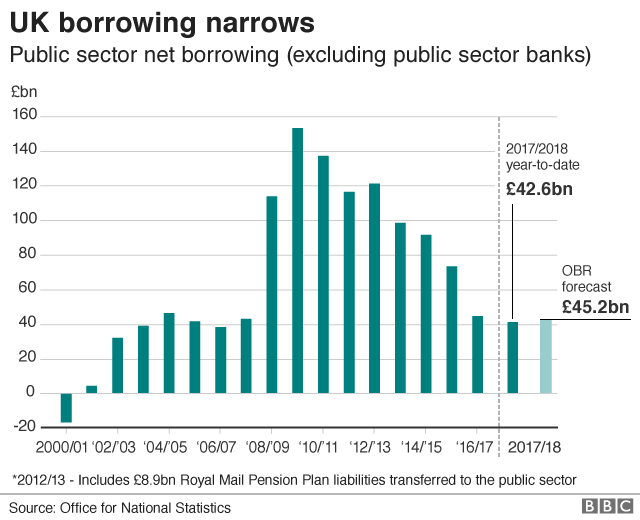
March's deficit was £1.3bn, well below a forecast for a gap of £3.25bn.
The borrowing figure does not include the amount spent on supporting the state-owned banks.
Mr Hammond has kept the broad aim of the previous chancellor, George Osborne, of reducing the gap between spending and borrowing, although he has eased off on the pace of cut-backs.
Mr Hammond said: "Thanks to the hard work of the British people, borrowing is the lowest in over a decade. Our economy is at a turning point with debt starting to fall and people's wages rising, as we build an economy that truly works for everyone."
'Key challenge'
But Samuel Tombs, chief UK economist at Pantheon Macroeconomics, said the figures did not necessarily indicate an improving economy: "Rapidly falling public borrowing continues to reflect sharp falls in spending, rather than a reviving economy.
"Lower borrowing in March than last year primarily reflected a £1.0bn decline in interest payments and a £1.4bn reduction in Local Authority borrowing. Both these expenditure components are volatile and tell us little about the underlying health of the economy."
John Hawksworth, chief economist at PwC, said: "The key challenge facing the chancellor in his Budget in November will be how to trade-off growing political pressures to ease austerity against his desire to get the debt ratio down as far as possible.
"The undershoot in the deficit this year has given the chancellor a little more wriggle room, but it does not alter the fundamental strategic choice he will need to make in November."
From: BBC News
Monday, April 16, 2018
Google owner Alphabet sees profits soar
Profits at Google-owner Alphabet jumped almost 73% in the first three months of the year, as revenues from internet advertising soared.
The strong results came despite fears that rising costs and regulation could undermine the search giant's performance.
First-quarter net income rose to $9.4bn (£6.7bn) from $5.4bn a year earlier, beating analyst expectations.
Revenue jumped 26% to $31.1bn from $24.8bn.
During the quarter, the search giant enjoyed a $3bn boost from a change to accounting rules, as well as a $1.1bn uplift from currency exchange movements.
However, it attributed much of the growth to higher pricing for online ads on its Google search engine, YouTube video service and partner apps and websites.
Ivan Feinseth, an analyst at Tigress Financial Partners, said: "The strong economy has companies spending more on advertising and we have an ongoing migration from traditional types of media advertising to greater online and social media-based advertising."
Mounting pressure
Alphabet's profit margins have fallen in recent quarters as it reinvests in areas of its business such as cloud computing and hardware.
Alphabet's profit margins have fallen in recent quarters as it reinvests in areas of its business such as cloud computing and hardware.
And the firm admitted capital spending almost tripled to $7.7bn during the first quarter.
Its shares have also fluctuated in 2018 amid mounting pressure from regulators to change its business practices.
Investors are particularly worried about the European Union's new General Data Protection Regulation (GDPR), due to come in on 25 May, which will give the public more control over their data and ramp up fines for data breaches.
Some analysts believe it could prompt some users to reject receiving personalised ads online, hitting Google's sales.
However, in a conference call with reporters, Google boss Sundar Pichai played down the concerns.
"GDPR is a fairly new public topic, but for us it is not new - we started working on it 18 months ago.
"We are working very closely with our publishers and our partners… It is a big effort, we are very committed to it and to getting it right."
Alphabet shares jumped almost 1% in after-hours trading before slipping back.
From: BBC News
Friday, April 13, 2018
You should pay more attention to Quality Control, here’s why
By Elyssa
Sourcing in China can be daunting, especially when you don’t have years of experience doing it. When you manage to avoid the pitfalls of selecting the right supplier, it’s time to get real with Quality Control.
Quality Control (QC) is a process implemented to ensure that a manufactured product adheres to a set of quality criteria and meets the requirements of the client or customer. As it’s often overlooked and lacks defined processes in most companies, it might generate important additional costs to your sourcing process.
In order to give you a few pointers on how to improve Quality Control in your company, we’ve met with Renaud Anjoran, founder at SynControl, who has over 10 years’ experience in quality control and helps buying offices manage their inspectors’ work better.
You co-founded SynControl, a software company for managing QC inspections. How did you come up with it?
There is a lack of process in the QC operations of most buying offices. To give a few examples:
There is a lack of process in the QC operations of most buying offices. To give a few examples:
- Inspectors work outside a strict framework, which means one inspector might find issues that his colleague wouldn’t find. It is a serious reliability issue.
- Managers often get partial information (a few photos through Wechat) outside of context, and get the full report much later at night.
- Issues detected by inspectors or auditors are not followed up and used for driving improvements.
What is, according to you, the most challenging part of QC?
For the QC manager, it is keeping a control over what happens when his/her team is working in suppliers’ factories, far away from the office.
For the individual inspector, it is balancing the needs of proper processes and reporting with the flexibility required because of the constant urgencies of production.
What would you say would be a typical good process for QC?
A few elements of a good QC process would be:
- Documented checklists and defect lists
- The inspector’s workflow is structured by the checklist
- Findings are documented immediately without extra time/effort
- The final report is available and distributed to the right people once the inspection is over https://www.sunchineinspection.com/services/
How does your software help with designing better Quality Control processes?
- Inspectors follow the checklist on their mobile app
- Photos/videos can be taken as fast on a smartphone/tablet as they were previously with a digital camera
- Once all the findings are sync’ed up to the server, the final report is generated automatically and sent by email.
I understand you have a lot of QC field experience, what’s the funniest thing that ever happened to you?
An inspector can see a lot of things, and sometimes hear a lot of things. In 2007 I had a client who was an importer. They purchased from a Hong Kong-based trading company that had a team in China to follow production. The client came and set up the lines and the machines when production was starting (or so they thought). Once the client was gone, the factory simply subcontracted the work to another workshop. The Chinese staff in the trading company was aware of it but not their managers in Hong Kong. When we came for the final inspection it was obvious there was an issue – we were finding defects that could only come from machines not set up by the client’s engineer. The client figured it out and they were quite upset. I am under the impression that the Hong Kong managers are still scratching their heads over what happened…
What’s your favourite feature of SynControl, the one thing that makes you proud?
The ability for office people to see what the inspector has found at any point during the day. Obviously it implies that the inspector’s mobile app is connected to the internet but in China that’s not an issue in 90%+ of cases.
Finally, If you had to give one advice for QC to our readers, what would it be?
If you define processes that make sense to your company, and you hire a certain profile of inspectors who like to follow a sequence of steps in a systematic manner, you will tend to do well. If you leave things to chance and hope for the best, you might be terribly disappointed.
Subscribe to:
Posts (Atom)
-
BY RENAUD ANJORAN This article introduces the different options available to buyers, when it comes to the representativity of inspection fi...
-
BUSINESS NEWSAPRIL 22, 2018 / 1:14 PM / BEIJING (Reuters) - China on Sunday said it welcomed plans by top U.S. officials to visit the coun...
-
BY RENAUD ANJORAN ‘AQL’ stands for ‘Acceptance Quality Limit’, and is defined as the “quality level that is the worst tolerable” in ISO 2...
