Monday, April 9, 2018

Sourcing from China 101, Part 8: Project Management of Your Orders

One recurring theme in this course is that you should not rely on the supplier’s salespeople.
Most of them would have been hired solely on the basis of their English skills. They are interpreters with very little technical knowledge, and they are not project managers.
There is actually no proper “project manager” in 99% of Chinese factories. So, who should manage the orders?
The bad news is, it’s the buyer’s job.
The good news is, it’s not necessarily much work.
Why the buyer should keep track of advances in production
In the sourcing phase and during new product development projects, the supplier has an interest in acting fast. He is “running after the order”.
The biggest source of delays, in these phases, is the buyer’s slow responses or imprecise information (unclear specifications, unclear feedback on samples…).
Once an order gets into production, though, the buyer should not simply wait for shipment. He should remain active and continue to communicate on a regular basis.
Chinese manufacturers are often late. For some of them, on-time deliveries are truly exceptional events. This is a fact you must count on.
So how do they communicate these delays to the buyer? If they see they will be 2 weeks late, will they announce it to their customer? Usually no, because they are afraid to get a response along the lines of “then you will pay for air freight”.
What they do instead, is wait until 1 week before the original planned shipment date, and then announce a few days delay (even though they might still be waiting for some components, and production hasn’t started). Then they announce a few more days, then a few more days and so on.
A 2-week delay sounds quite bad. A 3-day delay is not that bad. But five 3-day delays equate to one 2-week delay.
Beware of a perverse effect. It unfolds this way: the customer is so pressed by time, he decides to skip the final inspection; the supplier notices it and thinks to himself “that’s great, there is no inspection when we don’t leave enough time for it”. Believe me, it will shape their future behavior!
Are penalties for late shipment realistic and applicable?
I see many buyers who write this term on their purchase order: “Penalty: 1 week late 5% of the order, 2 weeks late 10%…”.
But very few actually try to enforce it. They know the supplier probably makes less than 10% margin and will not accept to lose money on the order.
So, is this term pointless and useless? No! You should use penalties as a threat.
Your goal is to avoid two situations:
  • Another buyer threatens to apply penalties and gets the priority over your order… Simply because you are playing it too nice with your supplier.
  • The factory makes your goods in a rush, to avoid penalties, and ends up creating huge quality problems. (And, by the way, they will have a convenient excuse — you pushed them to hurry up, so really it is your fault.)
Does this sound like a fine line to walk? Sometimes the purchaser’s job is an art more than a science…
How professional importers track production
From my observations, some buyers manage to avoid most problems I described above. Here are a few things they do well:
  • They check the factory’s capacity during the audit, to make sure they CAN make the order in a reasonable time frame.
  • They add 2-3 weeks of padding, on top of the supplier’s forecast.
  • For new products or new factories, they send an inspector during production. The idea is to check product quality, the production status, and whether the whole order is made in the approved manufacturing site.
  • They use project management techniques to track the advances in production.
How to follow a project management approach
Here is a simple table that can be used by purchasers, for every order.
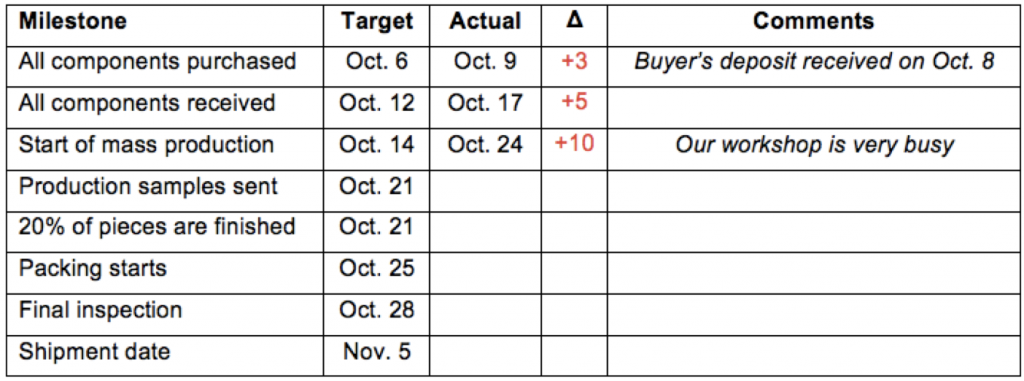
The problem is that, if you have several orders with several suppliers, the follow-up work quickly becomes too time consuming. We do some project management work for some of our clients and it saves them much time.
In any case, remember — email is NOT a project management tool. And Skype/Wechat are even worse. There needs to be other tools to structure followup and, when possible, also communication.

Sunday, April 8, 2018

Sourcing from China 101, Part 8: Project Management of Your Orders

BY RENAUD ANJORAN

Do you wonder why you still suffer from quality issues, even though the process is quite mature and seems to be well understood?
Or are you preparing to launch the production of a new product… or production of an existing product in a new factory? And you want to plan ahead to avoid missteps that might be quite costly?
There are 3 basic process improvement tools that you can use:
  1. The Process flow chart
  2. The Process FMEA (Failure Mode & Effects Analysis)
  3. The control plan (both for product and for process)
And there is a logical order that you can follow. Let’s go through these documents one by one.

1. The Process Flow Chart

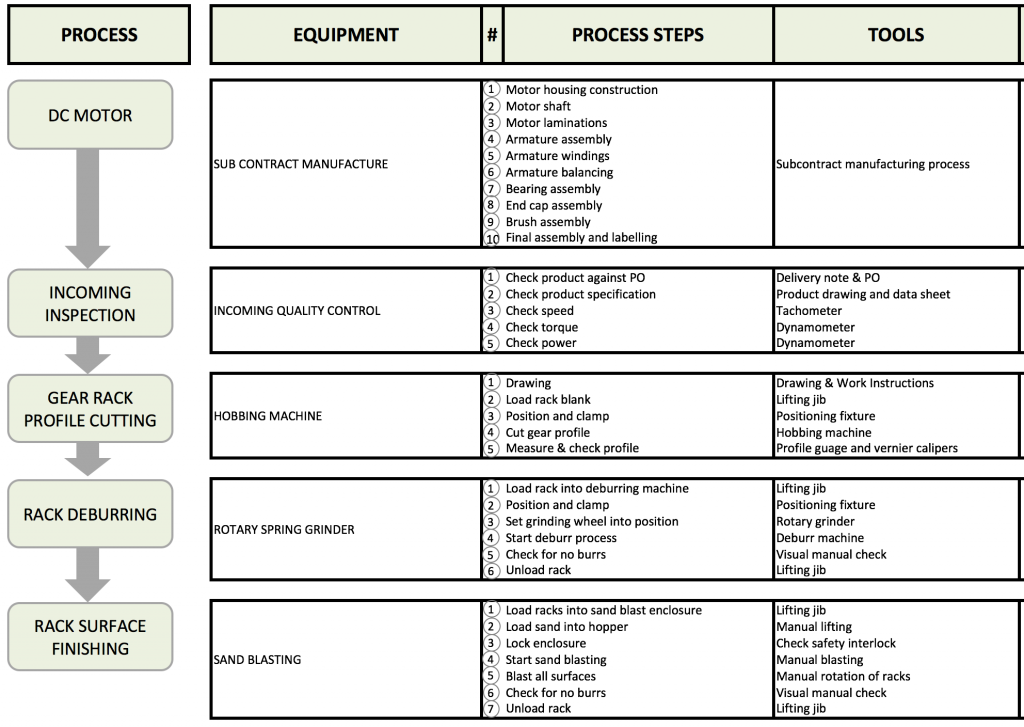
This is simply the mapping of the process steps. There are many templates you can follow, and here is an example.
Take a step back and look at this process. What steps can be combined (less picking & stacking, fewer mistakes, higher productivity)? Are there ways to eliminate one step (e.g. by clipping rather than positioning and then screwing)?

2. The Process FMEA

With the process map in hand, walk on the factory floor and observe each step. for each process, make a list of things that might go wrong (the “failure modes”). Bring in people from different teams and backgrounds if possible.
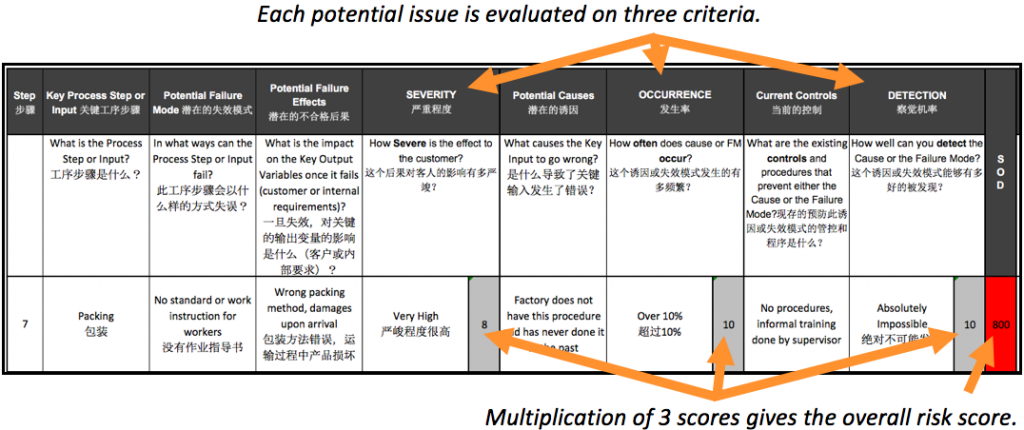
The FMEA is a great way to assess the risks and to rank them. The 3 components of risk in this form are:
  • Severity of the impact (on the customer, on the downstream process…) if it happens
  • Occurence — how often it is expected to happen
  • Detection — how likely is it to be caught before it has an impact?
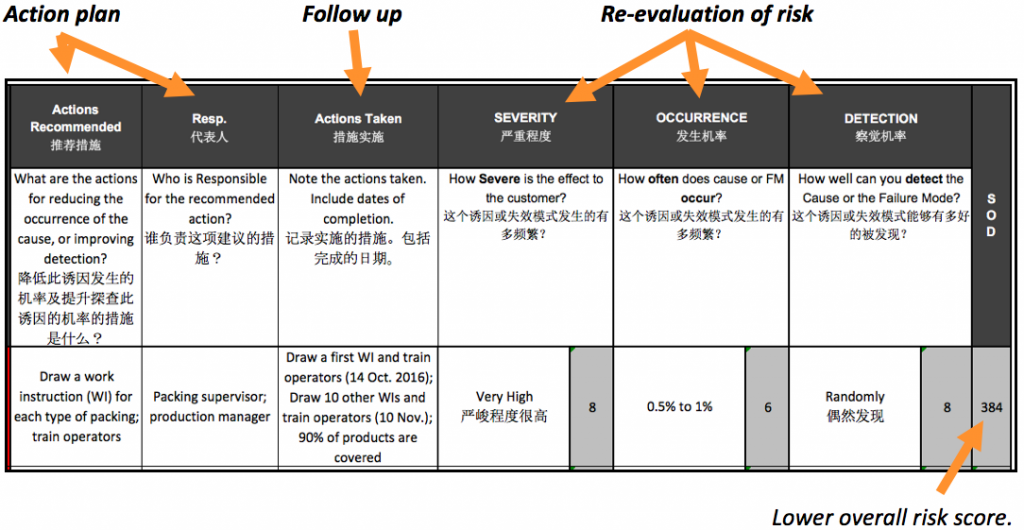
And then, for each failure mode, it drives an action plan. It is a living document and should be updated often. Followup on countermeasures on the FMEA(I covered the Process FMEA in more detail here.)
A word of caution. It is not an easy exercise. Don’t expect a production supervisor or a quality auditor to do it nicely without prior training and experience.
In theory it is tool to think of issues that might come up in the future. But an easier way to start is to include the issues that issues that came up in the past… if that process has been in place for some time.

3. The control plan

Based on the above documents, you have:
  1. A map of the process steps
  2. A ranking of the highest risks to watch out for
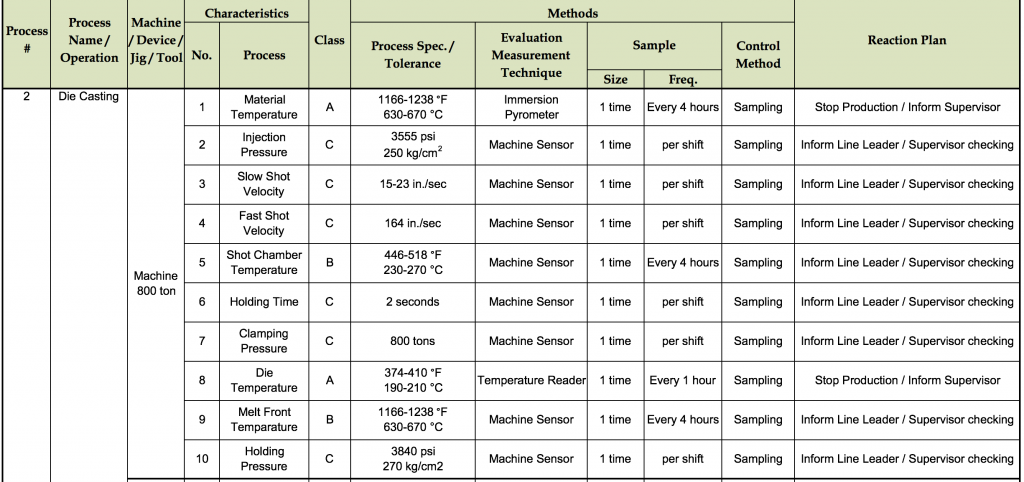
This the basis for a good control plan — the central document that the factory should use to drive the process’ capability up (in other words, improve process controls so as to get better product quality).
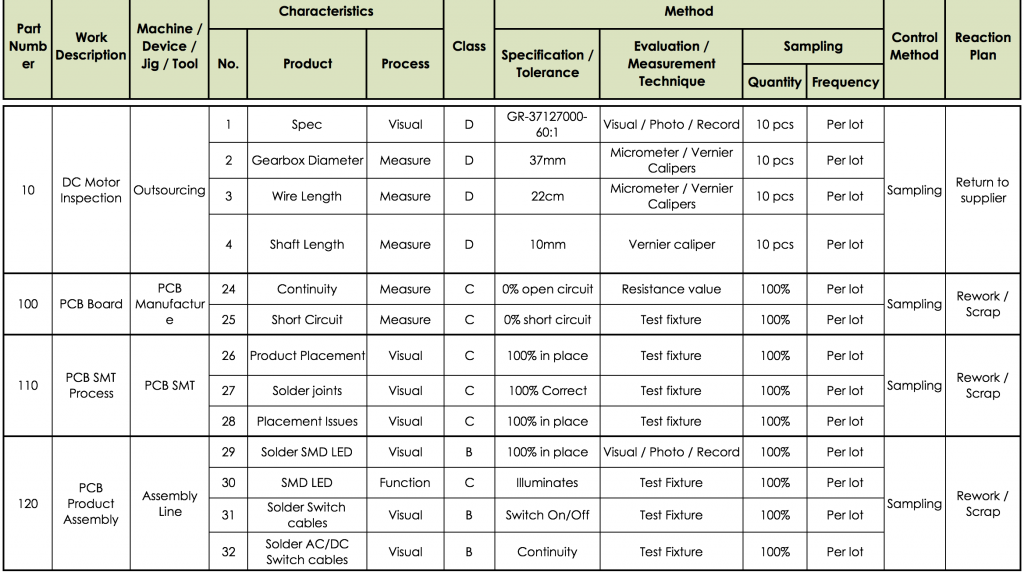
A good control plan includes:
  • Process controls — in this example, what to check regularly on a die casting machine to ensure it works properly. (Note that the mould and the materials also need to be checked regularly — it’s not only about the machine.)
  • Product controls — in this case, inspection of incoming components and inspection of some characteristics of semi-finished products. (It should also include inspection of completed products, obviously.)
Based on the control plan, proper work instructions can be given to the main interested parties:
  • Production operators (who need to achieve that plan and do some of the checks when appropriate)
  • Quality inspectors & engineers (who need to do some of the checks)
  • Maintenance technicians (who need to know what the settings should be on the equipment)
  • Purchasers (who need to buy the right components & materials)
  • Customers (who need to know what specifications the manufacturer commits to, and who may want to audit the process controls)
—
I made this whole approach look very linear, but often those process improvement tools are developed at the same time. Each document feeds the other two.
Our consultants have developed these documents in a number of projects, with good results. They are quite powerful.
What do you think? Do you, or your suppliers, use these tools?

Tuesday, April 3, 2018

inspection service quality control

Sunchine Inspection, a professional one-stop international inspection provider, focus on providing more flexible and humanized inspection service to clients from all over the world.

Sunchine Inspection, Thinking for you and doing for you!


- - - - - - -✂ - - - - - - - - - - - - - - - - - - -✂ - - - - - - - - - - - - - - - - -✂ - - - - - - - - - - - - - - - - -

How does a random quality inspection work? [infographic]

BY RENAUD ANJORAN
On the last trade show I attended, I noticed that I explained over and over again how we perform random quality inspections. There must be a better way to pass this message.

A graphic designer helped me render it visually, and here is the result:

Random quality inspection

To go further: lots of great information about inspections on this page.

——–


TRANSCRIPT:

FINAL RANDOM INSPECTIONS – How is quality controlled before shipment?

Most consumer goods exported from low-cost Asia to Europe and the USA are inspected randomly. For example, for an order of 8,000 pieces, only 200 samples are selected for inspection. How can an inspector draw valid conclusions after checking some pieces at random?

Here is how it works.

1. COMMUNICATION OF REQUIREMENTS

The purchaser describes his product: specifications, dimensions, labeling, packaging… The more precise the information, the more you take advantage of the inspection. If possible, an approved sample can be sent for the inspector’s reference.

2. AN INSPECTOR GOES TO THE FACTORY

When? After all production is finished and packed, and about 2 days before the goods leave the factory inspection service.

(In most cases, one inspector is enough)

3. QUANTITY VERIFICATION

The cartons are counted, to check if the whole quantity is presented. Then the inspector randomly selects a few cartons, opens them, and checks their content.

4. RANDOM SELECTION OF SAMPLES

Some samples are taken from each of these cartons, totally randomly. The inspector follows industry-standard statistical rules to ensure his findings are valid.

5. COSMETIC AND WORKMANSHIP CHECK

These samples are checked thoroughly for visual defects. A defect is an imperfection on the product (or its packaging). The statistical rules provide a maximum number for each type of defect. If there are too many defects, the inspection is failed.

6. CONFORMITY VERIFICATION

The inspector also checks if the goods presented by the factory correspond to the purchaser’s requirements. For example, the products might be too small, in the wrong color, incorrectly labeled, or insufficiently protected.

7. TESTING IN THE FACTORY

The inspector performs some tests that are specific to the product, with the factory’s equipment. Tests vary according to the nature of the products. A few examples: checking if there is current leakage on an electrical device; checking if a piece of furniture falls over easily; checking if the export carton is strong enough.

8. REPORT PREPARATION

The inspector issues a report that describes the situation and illustrates it with photos. It documents his findings about presented quantity, visual defects, conformity to requirements, and on-site tests.

“Here is my report. You have the info you need to take a decision(accept or refuse the shipment).”  FROM: qualityinspection

http://inspectionagency.soup.io
http://containerinspection.soup.io
http://companyverificationservices.soup.io
http://commoditiesinspection.soup.io
http://chinainspectionagents.soup.io
http://factorycheck.soup.io
http://factorycheckservice.soup.io
http://costcontrolservice.soup.io
http://clothinginspection.soup.io
https://imgur.com/gallery/OCoBcHE
https://imgur.com/gallery/6VeXqjy
https://imgur.com/gallery/7IBLctT
https://imgur.com/gallery/ch5eZpH
https://imgur.com/gallery/6ZyGL75
https://factoryinspection.imgur.com
https://imgur.com/gallery/e74A5Gn
https://imgur.com/gallery/kWsHMpI
https://imgur.com/gallery/kztQ8fz
https://imgur.com/gallery/gw68ljV
https://imgur.com/gallery/AvXDbfQ
https://imgur.com/gallery/qBAMftV
https://imgur.com/gallery/1agse7t
https://imgur.com/gallery/jhMeOJw
https://imgur.com/gallery/AvXDbfQ
https://imgur.com/gallery/tQfzp6o
https://imgur.com/gallery/F2kdPT2
https://imgur.com/gallery/DckvjdY
https://imgur.com/gallery/BiK2Y6i

inspection service ningbo

Sunchine Inspection, a professional one-stop international inspection provider, focus on providing more flexible and humanized inspection service to clients from all over the world.

Sunchine Inspection, Thinking for you and doing for you!


- - - - - - -✂ - - - - - - - - - - - - - - - - - - -✂ - - - - - - - - - - - - - - - - -✂ - - - - - - - - - - - - - - - - -

BY RENAUD ANJORAN

Four simple steps for starting to do quality control
Some importers have been buying from China for many years, and yet they have never done quality control in a professional manner. The science behind inspection protocols seems complex–nearly intimidating. Buyers don’t know where to start, and they don’t know how their suppliers will react.

On the other hand, quality control is a necessity for most shipments. The constant search for cheaper suppliers, the bad habit of subcontracting to lower-grade factories, and the high risk of communication mistakes, all make a strong case for systematic inspections.

So, how to start? What are the first steps? After helping a few importers to start doing quality control, here are the first four steps I recommend.

1. Establish clear expectations
Some buyers choose a sample, negotiate a price, and then wait for delivery. This might work for off-the-shelf (standard) items with low quality/safety constraints, but not for most made-to-order products. And, think about it: on what basis will an inspector approve–or reject–a production?

You should try to get perfect/golden samples (i.e. representative of what you expect to get out of bulk production), but this is usually not enough. You also have to prepare–or confirm, if your supplier accepts to do it–a list of specifications. And these specs will become the checkpoints for the inspector. See this useful infographic: How to prepare a quality inspection checklist.

2. Don’t focus on final inspections
Final random inspections are a good tool for approving all aspects of production (total quantity, product specs, aesthetics, packaging…). But they tend to put a lot pressure on the supplier: what happens if serious non-conformities are found at that time? It is too late. The risks for a factory that gets caught are pretty high: re-work of the goods, re-production, penalties, air freight, or even order cancellation…

Instead of sending inspectors at the end (i.e. using them as policemen), try to send them when the goods are in process. Issues can get caught and corrected early: this is not only an extra safety for the buyer, but also a helping hand for the factory. This is how you should frame the discussion when you tell your suppliers about your QC intentions.

Early inspections (during production) have several positive side effects. They are a way to ensure that production is taking place in the right factory. Samples can be picked up randomly for lab testing. And it can prevent long shipment delays if the factory corrects course immediately after quality issues are noticed.

Don’t get me wrong, Chinese suppliers will not welcome this idea warmly. Many of them see QC inspectors as a nuisance. I have seen long-time suppliers of an importer (more than five years) getting used to inspections… But they would never admit that it is a necessity. Which leads me to the third step.

3. Inspections are not an option
You should be careful about the signals you send to your suppliers. Small things can go a long way:

You should write “Quality inspection required prior to shipment” on your P/Os.
If you pay by letter of credit, you can require a passed inspection report from your nominated QC provider.
When you develop new products, ask extra samples for the inspector’s use.
Keep track of the final inspection date and the shipment date, not just the shipment date.
All this is quite standard, and thousands of importers follow these tips.


You still have the freedom not to book an inspection for a given shipment, or to do skip-lot inspections for the most reliable suppliers. But you are the one to take this decision, not your suppliers. They should see inspectors as an extension of your organization. On the other hand, you should make sure you work with professionals who will be respected by factories.

4. Find the right balance between helping and arm-twisting inspection quality service
A buyer can play it “tough”, be “easy” on his suppliers, or find the right balance in between.

The “tough” way: a focus on final inspections performed rigidly.

Suppliers have no choice: either they comply with the rules, or they are charged penalties and/or re-inspection fees. Charge-backs are triggered by late changes in planning or non-respect of quantity requirements, for example. The fees are charged by the inspection firm to the importer, who re-invoices everything to the supplier.

It works well for large buyers who are adequately organized and who have the power to charge penalties systematically. But small-and-medium-sized importers can seldom play this game.

The “easy” way: in-line inspections and/or tailored final inspections.

As noted above, inspections during production don’t create much adversarial tension, and there is less timing pressure.

Once production quality has been secured, final inspections can be a little less formal. Why? Because it is less risky to loosen requirements about the proportion of presented products.

This “easy” way is only possible if you have at least *some* trust in your suppliers. It is technically possible–but rather difficult–for them to cheat.  FROM: qualityinspection

Any other tips, anyone?

http://inspectionagency.soup.io
http://containerinspection.soup.io
http://companyverificationservices.soup.io
http://commoditiesinspection.soup.io
http://chinainspectionagents.soup.io
http://factorycheck.soup.io
http://factorycheckservice.soup.io
http://costcontrolservice.soup.io
http://clothinginspection.soup.io
https://imgur.com/gallery/OCoBcHE
https://imgur.com/gallery/6VeXqjy
https://imgur.com/gallery/7IBLctT
https://imgur.com/gallery/ch5eZpH
https://imgur.com/gallery/6ZyGL75
https://factoryinspection.imgur.com
https://imgur.com/gallery/e74A5Gn
https://imgur.com/gallery/kWsHMpI
https://imgur.com/gallery/kztQ8fz
https://imgur.com/gallery/gw68ljV
https://imgur.com/gallery/AvXDbfQ
https://imgur.com/gallery/qBAMftV
https://imgur.com/gallery/1agse7t
https://imgur.com/gallery/jhMeOJw
https://imgur.com/gallery/AvXDbfQ
https://imgur.com/gallery/tQfzp6o
https://imgur.com/gallery/F2kdPT2
https://imgur.com/gallery/DckvjdY
https://imgur.com/gallery/BiK2Y6i-

inspection service in furniture

Sunchine Inspection, a professional one-stop international inspection provider, focus on providing more flexible and humanized inspection service to clients from all over the world.

Sunchine Inspection, Thinking for you and doing for you!


- - - - - - -✂ - - - - - - - - - - - - - - - - - - -✂ - - - - - - - - - - - - - - - - -✂ - - - - - - - - - - - - - - - - - -

BY RENAUD ANJORAN

The 4 ways of checking product quality before shipment
I can see four solutions for checking product quality before the goods are shipped out (remember, it is extremely hard to send a container of defective products back to China).

Inspections by external inspector(s) in the factory
This is the most common type of quality inspection service. An inspector goes in the factory, takes some samples randomly (based on the AQL tables), and draws a conclusion about the whole batch.

It is typically performed by a third-party quality control agency, or by the buyer’s in-house QC staff.

In 80-90% of cases, it is conducted after production is finished. Depending on the report conclusion, the importer accepts or rejects the shipment.

Pros:

The final random inspection is the “standard” way of checking quality. Suppliers are used to it.
It is easy to set up and relatively inexpensive, even with many different suppliers in many different places.
Cons:

The supplier might interfere in several ways: only showing a part of production (usually because they are late), bribing the inspector, or shipping other products if the inspector does not stay until the container is sealed.
If the purchaser only sends an inspector after production is over, and if the inspection is failed, the supplier might refuse to rework the goods. He might wait until the purchaser is obliged to deliver his own customers’ orders.
Final inspections on a platform
This solution is popular with some large buyers, mostly from Japan.

Once the goods are completed, they are brought by the supplier to a platform — usually a forwarder warehouse. A certain number of cubic meters of storage is rented, as well as inspection room(s).

Platform inspections are conducted either on a randomly selected set of samples, or on 100% of the goods.

Pros:

Inspectors are more productive (no need to travel), and the goods can be shipped immediately after acceptance.
No risk of supplier interference.
Cons:

Suppliers often resent this solution. If the inspection is failed, they have to pay for the transport back to the factory, sort & re-work the goods, and submit them again.
Not suitable for small and irregular volumes.
Piece-by-piece inspection in the factory
If you want to check 100% of production (once it is over), piece by piece inspection in the factory might be a good idea.

You basically set up the final quality control line in the factory, with inspectors that are not on the manufacturer’s payroll.

Pros:


The defect rate in the shipment is very close to zero after this 100% check.
The manufacturer sees what is rejected and needs to re-work it.
Cons:

Suitable only for large and regular volumes in one geographical area.
Can be expensive, depending on the number of inspectors to station in the factory
Training & auditing internal inspector(s) in the factory
Training an internal inspector is ideal for the following situation: you purchase more than 30% of a factory’s output, you have been working with them for more than a year, you trust them very much, and you need better reporting on your production (both on quality and on timing). inspection quality control services in electronic

Once an in-house inspector (on the factory’s payroll) has been trained and is dedicated to you, the key is to set up a reporting & auditing system. Then, the only ongoing cost is to audit his work (once every couple of weeks at the beginning, and less often if it runs fine).

Pros:

Much lower cost than sending third-party inspectors
In addition to controlling the products’ quality, the inspector can report on production status
Cons:

You need a high level of cooperation from the manufacturer (no interference at all)
There might be many complications if you purchase through a trading company
There are other solutions beyond inspection
As Deming wrote, the ideal is to “cease dependence on inspection to achieve quality. Eliminate the need for massive inspection by building quality into the product in the first place.”

You can do it by improving the reliability of the manufacturing process, and by reducing risks during product design. But this is outside the scope of this article… FROM: qualityinspection

http://inspectionagency.soup.io
http://containerinspection.soup.io
http://companyverificationservices.soup.io
http://commoditiesinspection.soup.io
http://chinainspectionagents.soup.io
http://factorycheck.soup.io
http://factorycheckservice.soup.io
http://costcontrolservice.soup.io
http://clothinginspection.soup.io
https://imgur.com/gallery/OCoBcHE
https://imgur.com/gallery/6VeXqjy
https://imgur.com/gallery/7IBLctT
https://imgur.com/gallery/ch5eZpH
https://imgur.com/gallery/6ZyGL75
https://factoryinspection.imgur.com
https://imgur.com/gallery/e74A5Gn
https://imgur.com/gallery/kWsHMpI
https://imgur.com/gallery/kztQ8fz
https://imgur.com/gallery/gw68ljV
https://imgur.com/gallery/AvXDbfQ
https://imgur.com/gallery/qBAMftV
https://imgur.com/gallery/1agse7t
https://imgur.com/gallery/jhMeOJw
https://imgur.com/gallery/AvXDbfQ
https://imgur.com/gallery/tQfzp6o
https://imgur.com/gallery/F2kdPT2
https://imgur.com/gallery/DckvjdY
https://imgur.com/gallery/BiK2Y6i

inspection service furniture

Sunchine Inspection, a professional one-stop international inspection provider, focus on providing more flexible and humanized inspection service to clients from all over the world.

Sunchine Inspection, Thinking for you and doing for you!


- - - - - - -✂ - - - - - - - - - - - - - - - - - - -✂ - - - - - - - - - - - - - - - - -✂ - - - - - - - - - - - - - - - - - -

BY RENAUD ANJORAN

The 4 types of quality inspection services
Four types of quality inspection services are usually distinguished. Each one corresponds to a particular step in the production process. They are all part of the toolbox of every importer, when it comes to buying in China and other low-cost Asian countries.

I tried to summarize the options available to buyers, in a visual manner.

The four types of quality inspection services:
Quality inspection services

All quality inspection services are not adapted to the same situation:


1. A pre-production inspection tells the buyer which kind of raw materials (or components) will be used. Factories are often suspected of lowering their costs by purchasing substandard materials, and this can be disastrous for the buyer (e.g. the wrong kind of chip in an electronic device). inspection quality control services

The pre-production inspection can also focus on the processes followed as production starts. Sometimes this can also be critical, as Chinese factories very often cut corners and do not respect the buyer’s blueprints (e.g. patterns for cutting fabric are received from the buyer, and they are modified to make the process easier and faster).

2. A during production inspection (often called “DUPRO” in the industry) allows the buyer to have an idea of average product quality, early in the production cycle. It is the most useful and the most under-rated tool at the disposal of importers, who often only rely on final inspections.

It usually takes place once some finished products have come out of the lines. If quality issues are found, what is already produced might be re-workable, and corrective actions can be taken for the rest of the job. It gives buyers the time to plan ahead, and even to avoid delays (repairs and re-inspections take much more time when problems are noticed after all production is finished).

3. The final random inspection (also called “pre-shipment inspection”) is by far the most common type of QC check. It takes place once 100% of shipment quantity is finished and at least 80% is packed, so it can be a real random inspection (this is not exactly the case if quality is checked earlier earlier) and suppliers cannot play games.

It puts pressure on suppliers and gives power to buyers. Its objective is really to confirm a shipment’s quality, rather than catching issues early. Therefore I usually advise my clients to complement final inspections with a DUPRO, to avoid finding disasters at the last minute.

4. The container loading inspection, like the pre-production inspection, it is seldom used. But it can be a worthwhile option in some specific cases.

It can be useful if the buyer has a precise loading plan and needs it to be respected very precisely (e.g. some cartons are too fragile to be placed at the bottom), or if the packaging is not conventional (e.g. some garments hung on bars, with no carton protection).

It can also ensure that the right kind of products are shipped out in the right quantity, when the importer places no trust in his supplier or when several suppliers bring their products for consolidation.

Only the most sensitive projects require all four types of inspection. Generally, only one or two of these tools are used, depending on the risks identified by the buyer.

These quality inspection services are used mostly for consumer goods involving little customization. Different approaches are often chosen for ensuring that industrial products are up to specs (much more attention is spent during development and early production).  FROM: qualityinspection

http://inspectionagency.soup.io
http://containerinspection.soup.io
http://companyverificationservices.soup.io
http://commoditiesinspection.soup.io
http://chinainspectionagents.soup.io
http://factorycheck.soup.io
http://factorycheckservice.soup.io
http://costcontrolservice.soup.io
http://clothinginspection.soup.io
https://imgur.com/gallery/OCoBcHE
https://imgur.com/gallery/6VeXqjy
https://imgur.com/gallery/7IBLctT
https://imgur.com/gallery/ch5eZpH
https://imgur.com/gallery/6ZyGL75
https://factoryinspection.imgur.com
https://imgur.com/gallery/e74A5Gn
https://imgur.com/gallery/kWsHMpI
https://imgur.com/gallery/kztQ8fz
https://imgur.com/gallery/gw68ljV
https://imgur.com/gallery/AvXDbfQ
https://imgur.com/gallery/qBAMftV
https://imgur.com/gallery/1agse7t
https://imgur.com/gallery/jhMeOJw
https://imgur.com/gallery/AvXDbfQ
https://imgur.com/gallery/tQfzp6o
https://imgur.com/gallery/F2kdPT2
https://imgur.com/gallery/DckvjdY
https://imgur.com/gallery/BiK2Y6i

inspection service

Sunchine Inspection, a professional one-stop international inspection provider, focus on providing more flexible and humanized inspection service to clients from all over the world.

Sunchine Inspection, Thinking for you and doing for you!


- - - - - - -✂ - - - - - - - - - - - - - - - - - - -✂ - - - - - - - - - - - - - - - - -✂ - - - - - - - - - - - - - - - - - -
BY RENAUD ANJORAN

Many importers lament that Chinese suppliers don’t take any responsibility when quality issues are found after shipment. Ten years ago, I would have confirmed that it happens less than 0.1% of the time. These days, it seems to become more common.

I talked about this with a client last week, and here is   inspection quality control  what came out of our discussion. I listed 5 ways to increase your chances, as a buyer.

1. Work with a manufacturer
Again, ten years ago, I would have suggested to work with a trading company — they often try to do everything they can to keep the customer happy. But, as their margins eroded, they can’t play that game as well as in the past.

In contrast, manufacturers value their ‘direct’ customers (those they work with without any intermediary in the middle) more than indirect ones. And they understand more and more that saving a little money in the short term is not in their long-term best interest.


2. Maintain a long-term relationship
Do you show your suppliers that they are constantly at the risk of losing your orders? Do you switch to a competitor to save a few cents? In that case, suppliers might not value your business. They know they are always on the brink of losing it.

If you have purchased from the same source for 5 years, and if you run into quality issues, they will think twice before refusing to give you a rebate or a reimbursement for a mistake they have made.

3. Go and see them face to face often
If all your suppliers see is your emails, they don’t feel they know you, which means they don’t necessarily trust you or value your relationship. This is true in many Asian cultures.

So, go and meet with them face to face 4 times or more every year. Take a little time out of the meeting room. Eat lunch with them and talk about non-business subjects. Have dinner with them (a good tip: tell them you have a call at 9:30pm in your hotel).

On the other hand, don’t let them give you such a nice treatment that you feel obliged to you. They need to keep in mind that, should they make an expensive mistake, you will get back at them immediately.

4. Compare findings to agreed-upon specs
Hopefully you have a solid and detailed specification sheet that includes tolerances for acceptability.

(If you deal with soft goods, it might be an approved sample, along with boundary samples where needed.)

Make the problem obvious. Remind the factory people what standard they promised to comply with, and show them precisely how production is noncompliant.

5. Translate the issue into facts they can understand
Extra points if you understand where the issue comes from and you can point to what exact mistake they have made. Factory salespeople and managers often need to be shown what happened before they start to react.

For example: “you cut this part a bit too small, and now it doesn’t fit that other part”, or “die casting was done at the wrong pressure, and your mold can no longer close properly”.

—

I hope it’s helpful…

Obviously this is more true in consumer electronics than in footwear, for the simple reason that factories make more margin. Also, if the buyer has invested a lot of time developing a new product, the supplier knows he is captive to a certain extent, and this can be a positive or a negative. Take this as very, very general advice!


FROM: qualityinspection

http://inspectionagency.soup.io
http://containerinspection.soup.io
http://companyverificationservices.soup.io
http://commoditiesinspection.soup.io
http://chinainspectionagents.soup.io
http://factorycheck.soup.io
http://factorycheckservice.soup.io
http://costcontrolservice.soup.io
http://clothinginspection.soup.io
https://imgur.com/gallery/OCoBcHE
https://imgur.com/gallery/6VeXqjy
https://imgur.com/gallery/7IBLctT
https://imgur.com/gallery/ch5eZpH
https://imgur.com/gallery/6ZyGL75
https://factoryinspection.imgur.com
https://imgur.com/gallery/e74A5Gn
https://imgur.com/gallery/kWsHMpI
https://imgur.com/gallery/kztQ8fz
https://imgur.com/gallery/gw68ljV
https://imgur.com/gallery/AvXDbfQ
https://imgur.com/gallery/qBAMftV
https://imgur.com/gallery/1agse7t
https://imgur.com/gallery/jhMeOJw
https://imgur.com/gallery/AvXDbfQ
https://imgur.com/gallery/tQfzp6o
https://imgur.com/gallery/F2kdPT2
https://imgur.com/gallery/DckvjdY
https://imgur.com/gallery/BiK2Y6i

China welcomes U.S. to visit China to discuss trade

BUSINESS NEWSAPRIL 22, 2018 / 1:14 PM / BEIJING (Reuters) - China on Sunday said it welcomed plans by top U.S. officials to visit the coun...